
Beam Summary#
The BeamSummary class lets you work with a list of beam sections and perform
checks, design, and report generation for all of them at once.
Creating Concrete and Steel Materials#
Define the concrete and steel materials to be used across all beams:
from mento.material import Concrete_ACI_318_19, Concrete_EN_1992_2004, SteelBar
from mento import MPa

# ACI 318-19
conc = Concrete_ACI_318_19(name="C25", f_c=25 * MPa)

# or EN 1992-2004
conc = Concrete_EN_1992_2004(name="C25/30", f_c=25 * MPa)

steel = SteelBar(name="ADN 420", f_y=420 * MPa)
Supported design codes: ACI 318-19, EN 1992-2004, and CIRSOC 201-25.
Loading Input Data from Excel#
The beam dimensions, forces, and reinforcement details are typically loaded from an Excel input file. The file should have a specific format and units, as shown below:
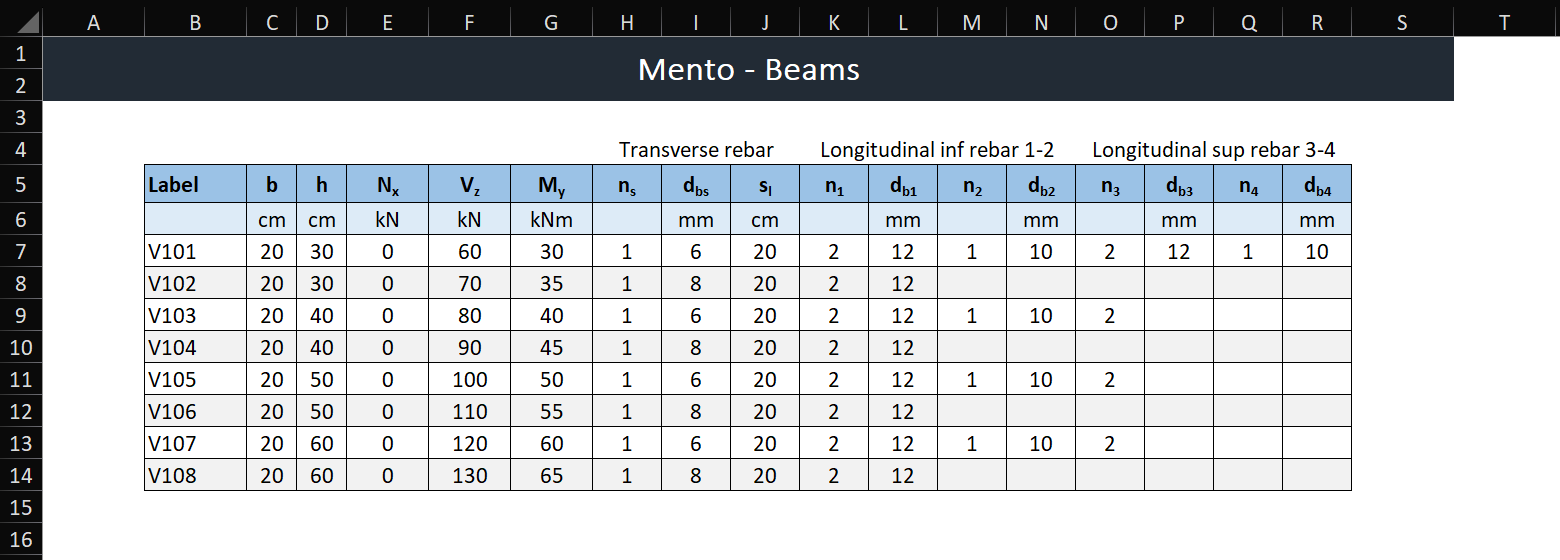
The recommended way to read the Excel file is with pandas:
import pandas as pd

input_df = pd.read_excel('Mento-Input.xlsx', sheet_name='Beams', usecols='B:S', skiprows=4)
The Excel file should contain the following columns:
Label: Beam identifier (e.g., V101, V102).
Comb.: Load combination label.
b: Beam width in cm.
h: Beam height in cm.
cc: Stirrup clear cover in mm.
Nx: Axial force in kN.
Vz: Shear force in kN.
My: Moment in kNm.
ns: Number of stirrup legs.
dbs: Stirrup diameter in mm.
sl: Stirrup spacing in cm.
n1, n2, n3, n4: Number of longitudinal bars per group.
db1, db2, db3, db4: Diameter of longitudinal bars in mm.
Bottom reinforcement is checked against positive bending moments; top reinforcement against negative bending moments.
For a quick test you can build the DataFrame manually:
data = {
    "Label": ["", "V101", "V102", "V103", "V104"],
    "Comb.": ["", "ELU 1", "ELU 2", "ELU 3", "ELU 4"],
    "b": ["cm", 20, 20, 20, 20],
    "h": ["cm", 50, 50, 50, 50],
    "cc": ["mm", 25, 25, 25, 25],
    "Nx": ["kN", 0, 0, 0, 0],
    "Vz": ["kN", 20, -50, 100, 100],
    "My": ["kNm", 0, -35, 40, 45],
    "ns": ["", 0, 1.0, 1.0, 1.0],
    "dbs": ["mm", 0, 6, 6, 6],
    "sl": ["cm", 0, 20, 20, 20],
    "n1": ["", 2.0, 2, 2.0, 2.0],
    "db1": ["mm", 12, 12, 12, 12],
    "n2": ["", 1.0, 1, 1.0, 0.0],
    "db2": ["mm", 10, 16, 10, 0],
    "n3": ["", 2.0, 0.0, 2.0, 0.0],
    "db3": ["mm", 12, 0, 16, 0],
    "n4": ["", 0, 0.0, 0, 0.0],
    "db4": ["mm", 0, 0, 0, 0],
}
input_df = pd.DataFrame(data)
Creating the BeamSummary Object#
Once the input data is ready, create a BeamSummary object:
from mento.summary import BeamSummary

beam_summary = BeamSummary(concrete=conc, steel_bar=steel, beam_list=input_df)
To verify that units were applied correctly, inspect the data attribute:
beam_summary.data
Checking Beam Capacity#
Use check() to get a summary table with DCR (Demand-Capacity Ratio) values for
all beams. Two modes are available:
Check with applied forces (uses the forces in the input data):
beam_summary.check()
Capacity check (zeros all forces to report section capacity only):
beam_summary.check(capacity_check=True)
The result is a DataFrame with identification, reinforcement, DCR columns, and a
pass/fail status (✅ / ❌). For EN 1992-2004 concrete, code-specific capacity columns
(MRd,top, MRd,bot, VRd) are added automatically; for ACI 318-19 and
CIRSOC 201-25 the equivalent columns are ØMn,top, ØMn,bot, ØVn.
Viewing Detailed Results#
For a full breakdown per beam use flexure_results() and shear_results().
Both methods accept an optional index (1-based) to retrieve results for a single
beam, and a capacity_check flag:
# All beams — forces from input
beam_summary.flexure_results()
beam_summary.shear_results()

# All beams — capacity check (adds MRd,top / MRd,bot or ØMn,top / ØMn,bot columns)
beam_summary.flexure_results(capacity_check=True)
beam_summary.shear_results(capacity_check=True)

# Single beam (1-based index)
beam_summary.flexure_results(index=2)
beam_summary.shear_results(index=2)
For step-by-step detail of a specific beam you can also access the node directly:
beam_summary.nodes[2].check_shear()
beam_summary.nodes[2].check_flexure()
Designing Reinforcement#
design() runs automatic flexure and shear design for every beam and returns a
DataFrame with the filled rebar columns (n1–n4, db1–db4, ns, dbs, sl):
designed_df = beam_summary.design()
Exporting and Importing a Design#
After running design(), save the result to Excel so it can be reviewed or edited:
beam_summary.export_design("BeamDesign.xlsx")
To reload an edited file and rebuild the summary with the new reinforcement:
beam_summary.import_design("BeamDesign.xlsx")
Exporting Results to Excel#
The DataFrames returned by check(), flexure_results(), and shear_results()
can be written to Excel directly:
beam_summary.check().to_excel("results.xlsx", index=False)
Detailed Word Report#
results_detailed_doc() generates a Word document (.docx) that contains:
Full flexure and shear detail for one selected beam.
Summary tables (beam data, flexure results, shear results, DCR check) for all beams.
The document is saved to the current working directory with the name
Beam_Summary_{design_code}.docx (e.g. Beam_Summary_ACI 318-19.docx).
# Detailed report with beam 1 as the reference beam (default)
beam_summary.results_detailed_doc()

# Use beam 3 as the reference beam
beam_summary.results_detailed_doc(index=3)
The index parameter is 1-based and must be within the range of beams in the
summary. An IndexError is raised for out-of-range values.